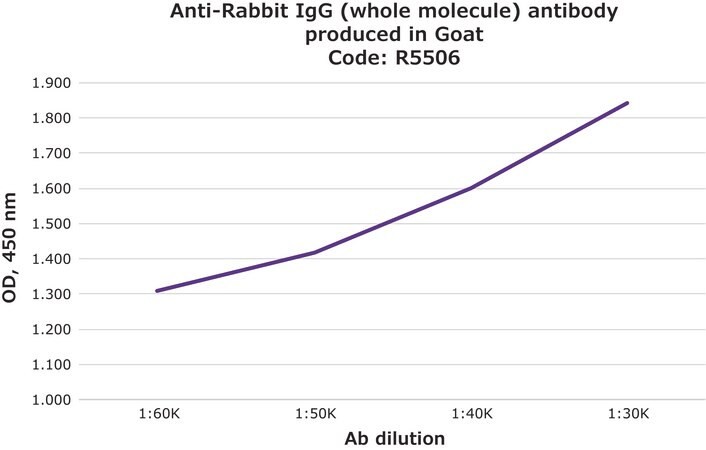
General description
Immunoglobulins (Igs) belong to the immunoglobulin
super-family and have two heavy (H) and two light (L) chains, held together by
disulfide linkages. The heavy chain has one variable N-terminal region and
three to four constant (CH1-CH4) C-terminal regions. The
L chain comprises of one variable N-terminal region and a constant C-terminal
region. IgG is an abundant protein in human serum. The four classes of IgG
include IgG1, IgG2, IgG3 and IgG4. The IgG heavy chain region is mapped to
human chromosome 14.
Rabbit immunoglobulins (IgGs) are often used as primary
antibodies in several protein assays. Thus, anti-rabbit IgGs can be used as
secondary antibodies to study and characterize target proteins bound to rabbit
IgGs. Anti-Rabbit IgG (whole molecule) antibody is specific for IgGs in
rabbits.
Immunogen
Rabbit IgG
Application
Anti-Rabbit IgG (whole molecule) antibody is suitable for
use in quantitative precipitin assay, immunoelectrophoresis,
immunohistochemistry , and laser scattering microscopy .
Anti-Rabbit IgG (whole molecule) antibody produced in goat
has been used as secondary antibody in vivo xenograft assay in
non-small-cell lung cancer (NSCLC) tissues and in western blotting detection in
endometrial sample from cattle.
Biochem/physiol Actions
Anti-Rabbit IgG (whole molecule) antibody is specific for
IgGs in rabbits.
Digestion of IgG by papain results in the generation of
fragment antigen binding (Fab). Pepsin digestion of IgG produces fragment
crystallizable (Fc). The Fc region of IgG antibody has enormous therapeutic
potential and is exploited for the development of therapeutic antibodies. IgG1
class is the most abundant and its deficiency results in hypogammaglobulinemia.
IgG2 deficiency increases susceptibility to bacterial infections. IgG3 mediates
effector functions, and IgG4 is associated with asymptomatic infection.
Physical form
Solution in 0.01 M phosphate buffered saline pH 7.4,
containing 15 mM sodium azide as preservative
Preparation Note
For continuous use, store at 2-8 °C for up to one month. For
extended storage, the solution may be frozen in working aliquots. Repeated
freezing and thawing, or storage in "frost-free" freezers is not
recommended. If slight turbidity occurs upon prolonged storage, clarify the
solution by centrifugation before use.
Disclaimer
Unless otherwise stated in our catalog or other company
documentation accompanying the product(s), our products are intended for
research use only and are not to be used for any other purpose, which includes
but is not limited to, unauthorized commercial uses, in vitro diagnostic uses,
ex vivo or in vivo therapeutic uses or any type of consumption or application
to humans or animals.