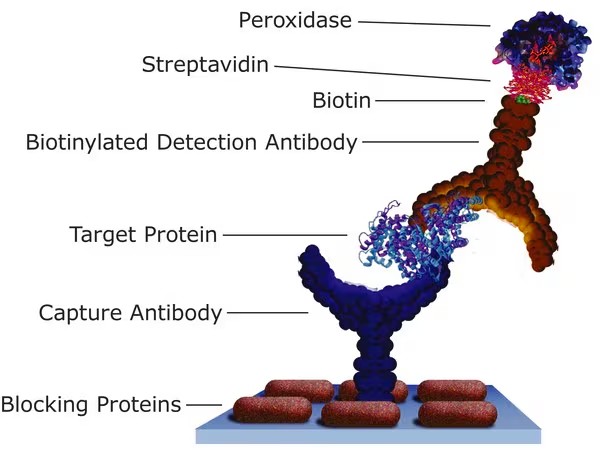
General description
Steptavidin is coupled to horseradish peroxidase (HRP) using
citrate buffer, pH 6.0, and a modified published procedure to form a 1:1
conjugate. HRP has a molecular mass of ~44kDa and steptavidin has a molecular
mass of ~60kDa.[1][2][3]
Streptavidin derives its name from its bacterial
source Streptomyces avidinii and from the hen egg-white
protein, avidin, which has high affinity to biotin. Its homologous core shares
33% sequence similarity with avidin, as well as sharing a common tetrameric
structure.[4] It is a crystalline tetrameric protein, with a molecular
weight of 4*15000Da. It binds four molecules of biotin.[5][6] Streptavidin
lacks carbohydrate and sulfur-containing amino acids.[7]
Streptavidin is considered as a high-affinity biotin-binding
agent, which shows resistance to extreme pH, detergents temperature,
denaturants and enzymes,[8] hence it is used in molecular biology and
bionanotechnology.
Application
Streptavidin- Peroxidase from Streptomyces avidinii has
been used for ELISA (enzyme linked immunosorbent assay) [9][10] and
Enzyme-Linked ImmunoSpot (ELISPOT).[11]
Streptavidin-Peroxidase from Streptomyces avidinii has
used as a secondary reagent for detection of biotinylated antibodies in
standard ELISA,[9][12] immunoblotting,[13] and
immunocytochemistry[14] procedures.
Biochem/physiol Actions
Streptavidin is an antibiotic that functions by binding to
and depleting the essential vitamin biotin from the surrounding
environment.[5] Because of its unique properties, streptavidin has found
various applications in biological studies, including immunotherapy,
immunoassays, hybridization assays, lymphocyte activation, antigen
localization, and affinity chromatography.[7]
Packaging
Package size based on protein content
Physical form
Lyophilized powder containing citrate buffer salts.
Preparation Note
Labeled with Type VI peroxidase by a modification of the
method of O′Sullivan, M.J., et al., FEBS Lett., 95, 311
(1978).
Purified by affinity chromatography.
Analysis Note
The optimal working dilution should be determined
empirically using a range of dilutions from a 1 mg/mL stock in buffer.
Other Notes
2024
CiteAb Award Winner for Supplier Succeeding in Parkinson′s Research
Disclaimer
Unless otherwise stated in our catalog or other company
documentation accompanying the product(s), our products are intended for
research use only and are not to be used for any other purpose, which includes
but is not limited to, unauthorized commercial uses, in vitro diagnostic uses,
ex vivo or in vivo therapeutic uses or any type of consumption or application
to humans or animals.