General description
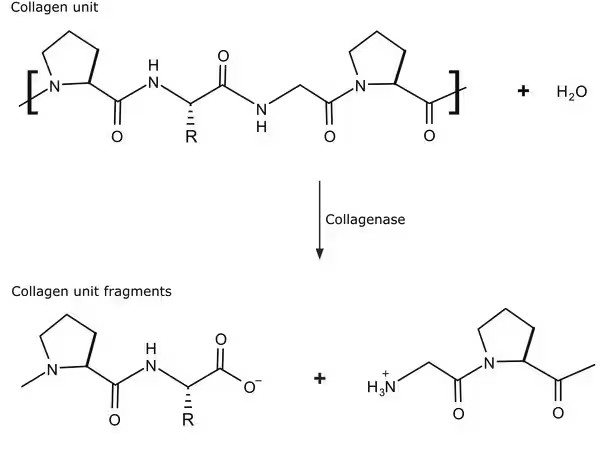
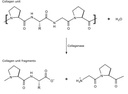
Collagenase is a protease which cleaves the triple-helical
protein called collagen. There are three types of tissue collagenases, and
these belong to the matrix metalloproteinases (MMP) family.[1] Collagenase
obtained from Clostridium histolyticum has a very strong
activity, as it digests collagen from both ends, at temperatures as low as
4-10°C.[2] Crude collagenase mixtures contain two major enzyme types
namely, collagenase and clostripain.[3]
Application
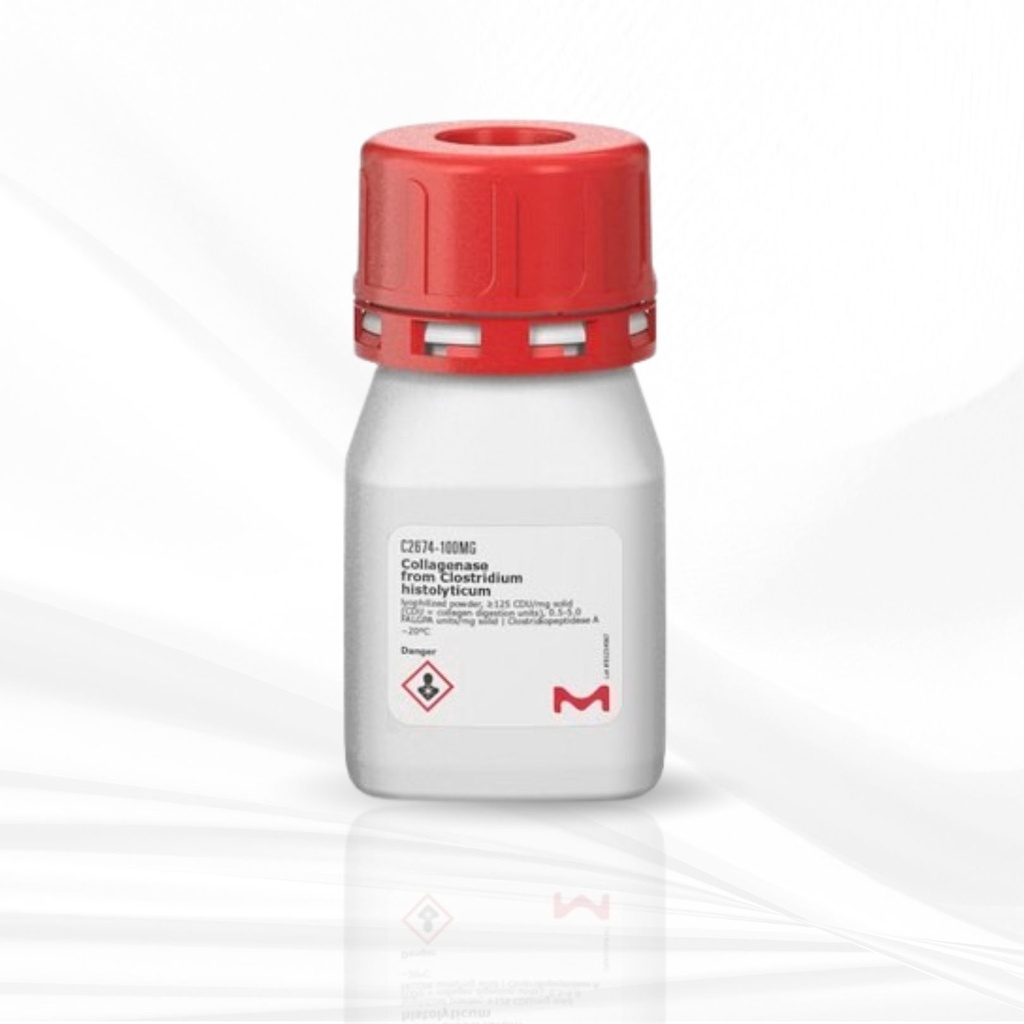
Collagenase from Clostridium histolyticum is
used for the following applications:
- Sertoli
cell isolation[4]
- Used
in the comparison of enzymatic methods[5]
- Used
during tissue preparations for immunocytochemistry[6]
- Testicular
sperm extraction[7]
- Preparation
of single cell suspensions[8]
- Immunofluorescence[9]
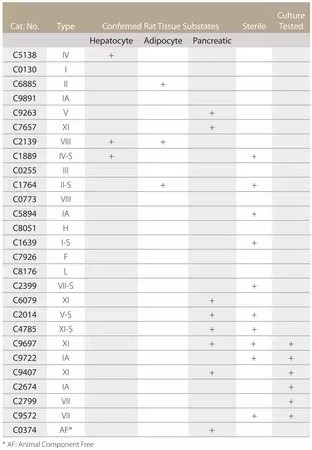
This product is suitable for the disaggregation of human tumor, mouse kidney,
human adult and fetal brain, lung and many other epithelia tissues. It has also
been shown to be effective in liver and kidney perfusion studies, digestion of
pancreas, isolation of nonparenchymal rat liver cells and hepatocyte
preparation. Collagenase has also been used in the preparation of arterial
tissue for the study of Advanced Glycosylation End Products. This enzyme has
been tested for the release of heptatocytes at a concentration of approximately
1mg/mL. Concentrations for digestion range from 0.1 to 5mg/mL.
Suitable for use in preparation of single cell suspension for sequencing.
Biochem/physiol Actions
Collagenase is activated by four gram atom calcium per mole
enzyme. It is inhibited by ethylene glycol-bis(beta-aminoethyl ether) - N, N,
N′,N′-tetraacetic acid, beta-mercaptoethanol, glutathione, thioglycolic acid
and 8-hydroxyquinoline.
The collagenase product is a mixture of enzymes secreted
by C. histolyticum, with different products differentiated by the
relative ratios of the 10-18 components found in the secreted enzymes. The main
components are two collagenases, clostripain, and a neutral protease. The
synergistic action of these enzymes degrade collagen and other intracellular
materialThe action of both collagenase enzymes and the neutral protease is
necessary for effective release of cells from tissue. Various types of collagen
are the natural substrates for collagenase.
Preparation Note
This collagenase is obtained from the culture filtrate of
Clostridium histolyticum. The culture filtrate is thought to contain at least 7
different proteases ranging in molecular weight from 68-130 kDa. This product
is Type I-A. Solutions are typically prepared at 1-2 mg/mL in TESCA buffer
(containing 50 mM TES, 0.36 mM Calcium chloride, pH 7.4 at 37°C.
Other Notes
One collagen digestion unit (CDU) liberates peptides from
collagen from bovine achilles tendon equivalent in ninhydrin color to 1.0 μmole
of leucine in 5 hours at pH 7.4 at 37 °C in the presence of calcium ions. One
FALGPA hydrolysis unit hydrolyzes 1.0 μmole of furylacryloyl-Leu-Gly-Pro-Ala
per min at 25°C. One Neutral Protease unit hydrolyzes casein to produce color
equivalent to 1.0 μmole of tyrosine per 5 hr at pH 7.5 at 37°C. One Clostripain
Unit hydrolyzes 1.0 μmole of BAEE per min at pH 7.6 at 25°C in the presence of
DTT.
Disclaimer
As supplied, this product is stable for one year at -20°C.
There is no loss in FALGPA or protease activity in 30 days at 37°C, 50°C and
-20°C. Solutions of crude collagenase are stable if frozen quickly in aliquots
(at 10 mg/mL) and kept frozen at -20°C. Further freeze-thaw cycles will damage
the solution. The product retains 100% activity over 7 hours when held on ice.