General description
Mitomycin C is a systemic chemotherapy compound and an
antibiotic obtained from Streptomyces caespitosus.[1][2] It is
the first bioreductive alkylating agent to be identified and is a derivative of
3-amino-5-hydroxybenzoic acid (AHBA), D-glucosamine, L-methionine and carbamoyl
phosphate.[3]
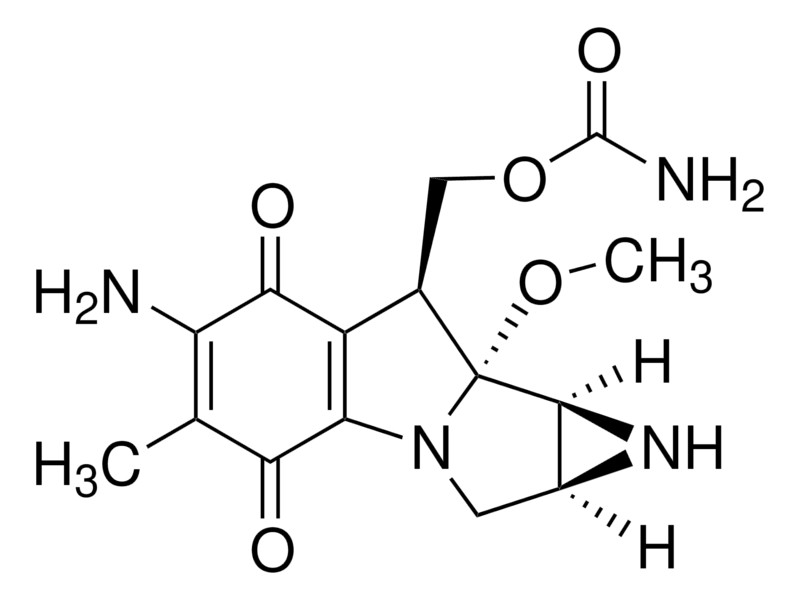
Chemical structure: Aziridine
Application
Mitomycin C from Streptomyces caespitosus has
been used for the treatment of feeder layers such as, PMEF (primary mouse
embryonic fibroblasts) and CD1 mouse embryonic fibroblasts (MEFs) for the
culture of hESCs (human embryonic stem cells).[4][5][6] It has also been
used for the treatment of BLC (basal-like cancer) cell line.[7]
Biochem/physiol Actions
Mitomycin C causes the cross-linking of double-stranded DNA,
which results in mutagenesis, inhibition of DNA synthesis, initiation of DNA
repair events, and activation of apoptosis. The capability to inhibit DNA
synthesis is attributable to the aminoquinone group present in mitomcyin
C.[3][8] This compound does not affect the synthesis of RNA and protein.
In tissue culture, this compound decreases cell viability and suppresses
mitosis, and causes disorganization of nucleus and the production of giant
cells.[2] Mitomycin C has potent anti-Gram negative and anti-Gram positive
activities.[8] It contains three moieties, quinine, urethane, and
aziridine groups. It is used to generate mitotically inactive feeder cells in
cell culture systems, such as the mitotically inactive fibroblasts used in
embryonic stem cell systems.
Mode of Action: This product is an alkylating
agent that specifically targets the guanine nucleoside sequence 5′-CpG-3′. It
inhibits DNA synthesis by covalently reacting with DNA, forming crosslinks
between complementary strands of DNA. This interaction prevents separation of
complementary DNA strands, inhibiting DNA replication.
Antimicrobial Spectrum: Mitomycin C has strong antitumor activity, especially
against Ehrlich ascites tumor cells, and strong bactericidal action against
gram-positive and gram-negative bacteria.
Preparation Note
Mitomycin C is soluble in water at .5 mg/mL, with a pH of
6.0-7.5. It undergoes rapid degradation in acidic solutions with pH<6, and
is mostly likely to retain activity in solutions with a pH between 6-9.
Disclaimer
This vial contains 2 mg Mitomycin C and 48 mg NaCl. Stock
solutions should be filter sterilized and stored at 2-8°C in the dark.
Solutions at pH 6-9 can be stored at 0-5°C for up to a week, but if a
precipitate forms, a fresh solution should be prepared - the precipitated
solution has been proven toxic to cells.