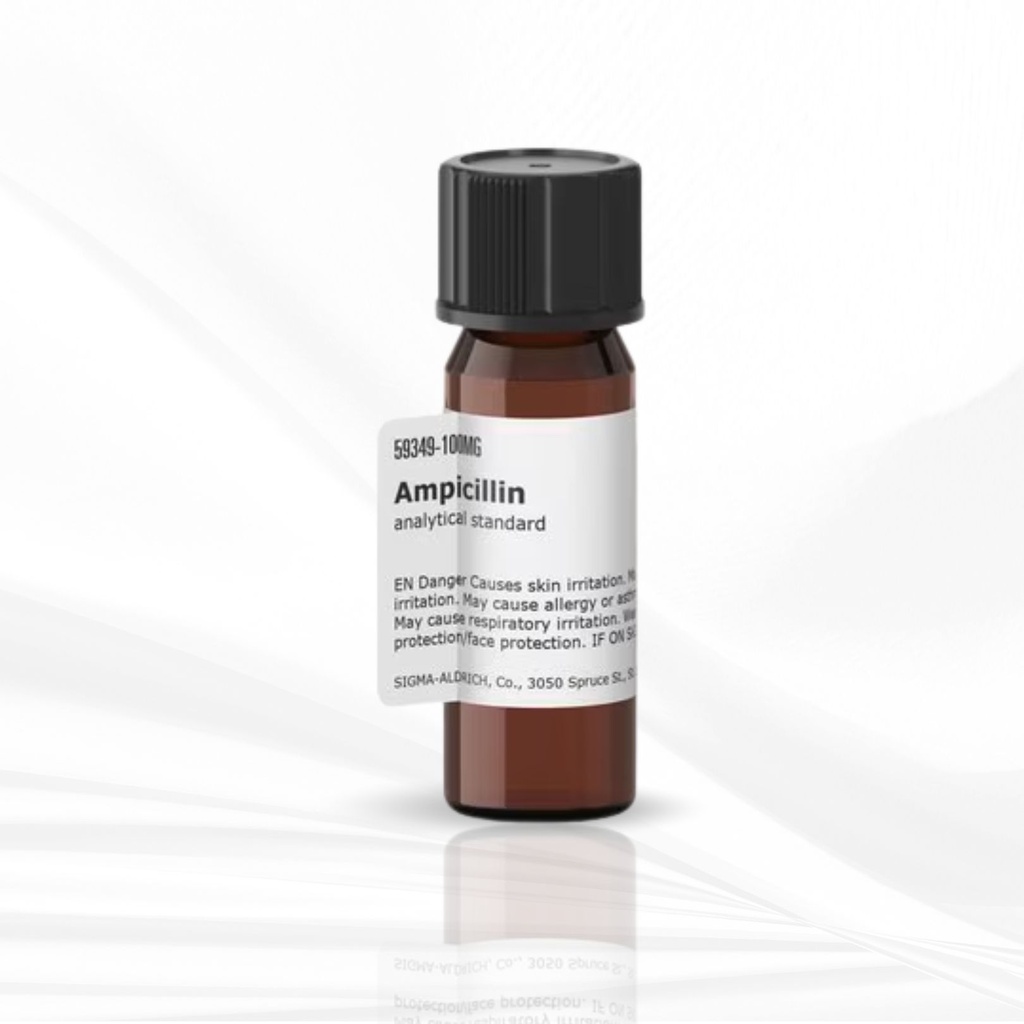
General description
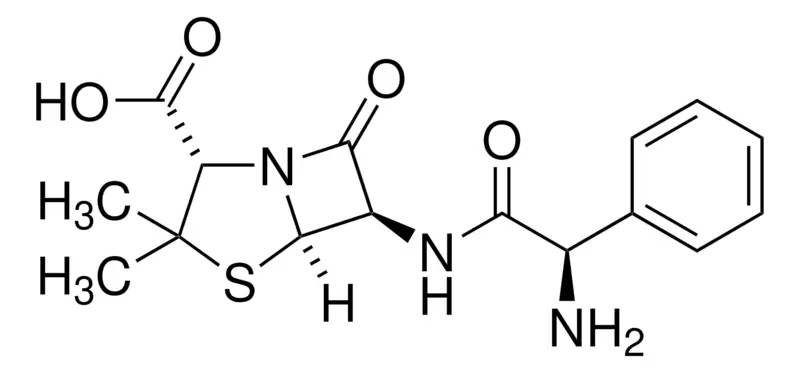
Chemical structure: β-lactam
Ampicillin belongs to the β-lactum group of antibiotics.[1] It is used to
treat bacterial infections via penetrating gram positive and gram negative
bacteria. Its mode of action basically involves the inhibition of bacterial
cell wall synthesis, thus leading to cell lysis.[2]
Application
Ampicillin has been used as a reference compound in the
determination of ampicillin free drug concentration in standard solution of
human serum albumin by micellar liquid chromatography method.[3][2][1]
Ampicillin is a semi-synthetic derivative of penicillin that
functions as a broad-spectrum antibiotic. It has been used to study antibiotic
resistance and penetration limitations, the synergy between multiple
antibiotics, certain bloodstream infections, and has been used to develop PCR
assays to detect resistance genes in cerebrospinal fluid.
Refer to the product′s Certificate of Analysis for more
information on a suitable instrument technique. Contact Technical Service for
further support.
Biochem/physiol Actions
Mode of Action: Ampicillin is a semisynthetic penicillin and
a ß-lactam antibiotic that inhibits bacterial cell-wall synthesis by
inactivating transpeptidases on the inner surface of the bacterial cell
membrane.
Mode of Resistance: Administration with ß-lactamase cleaves the ß-lactam ring
of Ampicillin and inactivates it.
Antimicrobial Spectrum: Effective against both Gram-positive (similar to
benzylpenicillin) and Gram-negative bacteria (similar to tetracyclines and
chloramphenicol.
Packaging
This product is packaged in a bottomless glass bottle with
the contents inside an inserted fused cone.
Preparation Note
Ampicillin is reported as slightly soluble in water,
practically insoluble in alcohol, chloroform, ether and fixed oils but soluble
in dilute acids or bases. The solution should not be autoclaved; a stock
solution should be sterilized through filtration and stored frozen, where it
will be stable for months.
Disclaimer
This product has been reported stable as supplied at 25°C at
43% and 81% relative humidity for six weeks. Additional studies have shown that
the stability of Ampicillin in solution is a function of pH, temperature and
the identity of the buffer. It′s activity is quickly lost when stored above pH
7. Optimal storage conditions are suggested as 2-8°C, and pH 3.8-5 where its
activity was retained at 90%+ for a week.