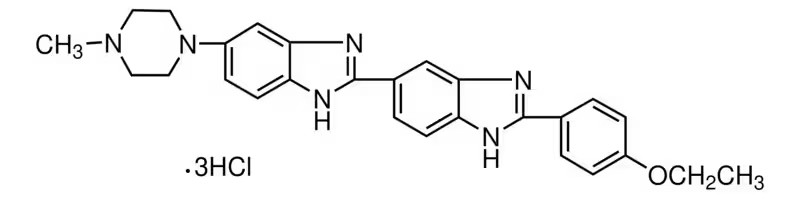
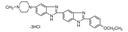
Empirical Formula (Hill Notation): C27H28N6O
· 3HCl · xH2O
CAS Number: 875756-97-1
Molecular Weight: 561.93
(anhydrous basis)
Beilstein: 1234011
MDL number: MFCD00012678
UNSPSC Code: 12171500
PubChem Substance ID:
24891639
NACRES: NA.47
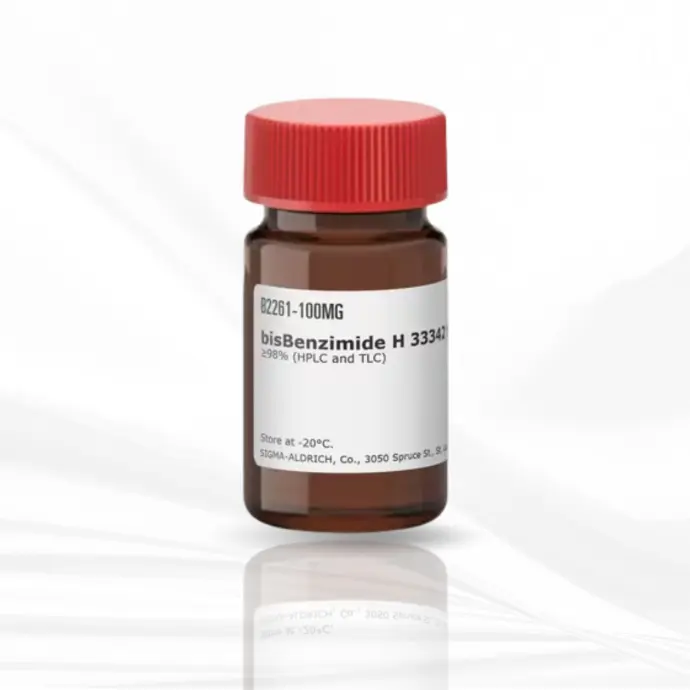
Product Name: bisBenzimide
H 33342 trihydrochloride, ≥98% (HPLC and TLC)
Quality Level: 300
Assay: ≥98%
(HPLC and TLC)
Form: powder
technique(s): titration:
suitable
color: yellow
pH: 1.7
(20 °C)
solubility:
H2O: 20 mg/mL
phosphate buffer: precipitates
Suitability: suitable
for fluorescence
application(s):
diagnostic assay manufacturing
hematology
histology
storage temp.: −20°C
SMILES string:
Cl[H].Cl[H].Cl[H].CCOc1ccc(cc1)C2=NCc3cc(ccc3N2)C4=NCc5cc(ccc5N4)N6CCN(C)CC6
InChI:
1S/C29H32N6O.3ClH/c1-3-36-25-8-4-20(5-9-25)28-30-18-22-16-21(6-10-26(22)32-28)29-31-19-23-17-24(7-11-27(23)33-29)35-14-12-34(2)13-15-35;;;/h4-11,16-17H,3,12-15,18-19H2,1-2H3,(H,30,32)(H,31,33);3*1H
InChI key: FYEVKHPLBHLWHK-UHFFFAOYSA-N
General description
Fluorescent properties of bisBenzimide H 33342:
Free dye: Excitation maximum = 340 nm, Emission maximum = 510 nm (5 mM HEPES,
10 mM NaCl, pH 7.0)[1] DNA complex: Excitation maximum = 355 nm, Emission
maximum = 465 nm (5 mM HEPES, 10 mM NaCl, pH 7.0)[1]
Application
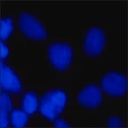
Bisbenzimide Hoechst 33342 is a specific stain for AT-rich
regions of double-stranded DNA and has been shown to displace several known DNA
intercalators.[2] This fluorescent dye has been used in sorting
living cells based on DNA content,[3] used in flow cytometry
for the determination of DNA content, and for the visualization of chromatin
distribution in living cells.[4] It has been used to detect
BrdU incorporation into cells[5] and in studying the initial
stages apoptosis and cellcycle distribution.[6],[7] Chromosomes
that are dividing or replicating will not stain with this dye.
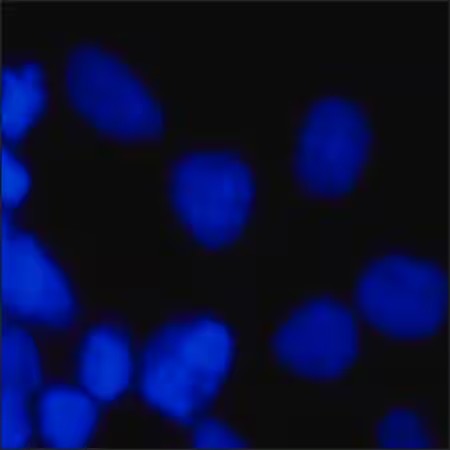
Useful for staining DNA, chromosomes and nuclei. May be used
for fluorescence microscopy or flow cytometry.
Excitation max. = 346 nm
Emission max. = 460 nm
Biochem/physiol Actions
Membrane-permeable, fluorescent DNA stains with low
cytotoxicity that intercalate in A-T regions of DNA.
Preparation Note
This product is soluble in water (50 mg/ml), yielding a
clear solution. The pH of a 2% solution is 1.9. It has been observed that this
material will precipitate from phosphate buffer solutions.
Aqueous solutions are stable for 1 month if kept in the dark at 2-8 °C.[4]