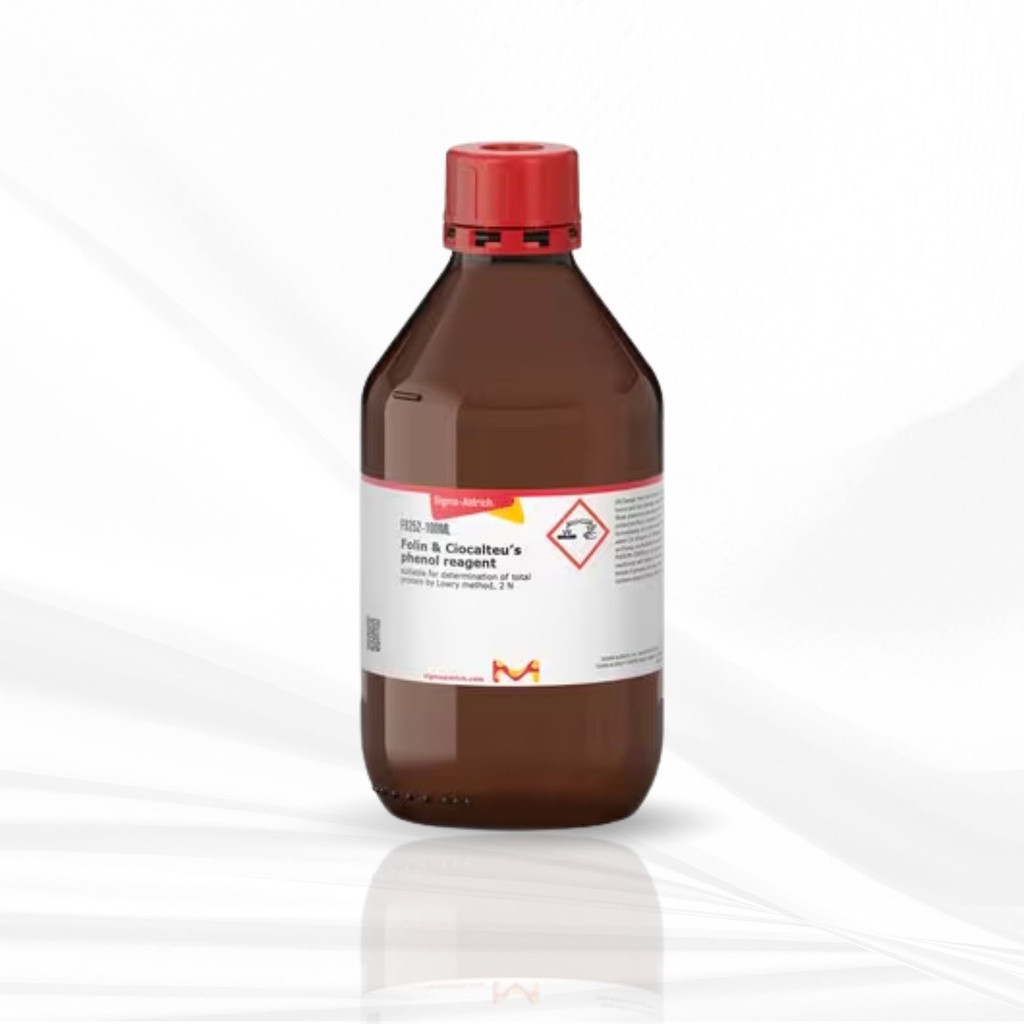
General description
Folin & Ciocalteu′s phenol reagent is most commonly used
in the Lowry method for determining protein concentration.[1][2] It has
also been used for the quantification of total phenolics.[3] In this
method, protein is pretreated with copper(II) in a modified biuret reagent
(alkaline copper solution
stabilized with sodium potassium tartrate). Addition of the phenol reagent
generates chromogens that give increasing absorbance between 550-750nm.
Normally, absorbance at the peak (750nm) or shoulder (660nm) are used to
quantitate protein concentrations between 1-100 mg/ml while absorbance at 550nm
is used to quantitate higher protein concentrations.
In the absence of copper, color intensity is determined primarily by the
tyrosine and tryptophan content of the protein, and to a lesser extent by
cysteine and histidine. Copper(II) has no effect on color formation by
tyrosine, tryptophan, or histidine, but reduces color formation due to
cysteine.[1][4][5][6][7]
Many modifications of the original assay procedure have been
published,[4] including methods for enhancing the color
development,[6][8] for determining the content of insoluble
proteins,[1][9] and for automating the procedure.[10] Compounds
including many buffers, chelating agents, detergents, and cyclic organic
compounds can interfere with the Lowry protein assay.[4]
Folin & Ciocalteu′s phenol reagent can also be used as a spray reagent in
chromatographic procedures.
Application
Folin & Ciocalteu′s phenol reagent has been used for the
estimation of total phenolic content in samples.[11][12][13]
Other Notes
Folin & Ciocalteu′s phenol reagent does not contain
phenol. Rather, the reagent will react with phenols and non-phenolic reducing
substances to form chromogens that can be detected spectrophotometrically.
This product is also available as part of a kit.