Grade: primary
reference standard
product line: phyproof® Reference
Substance
Assay: ≥98.0%
(HPLC)
manufacturer/tradename:
PhytoLab
application(s): food
and beverages
format: neat
storage temp.: −20°C
SMILES string:
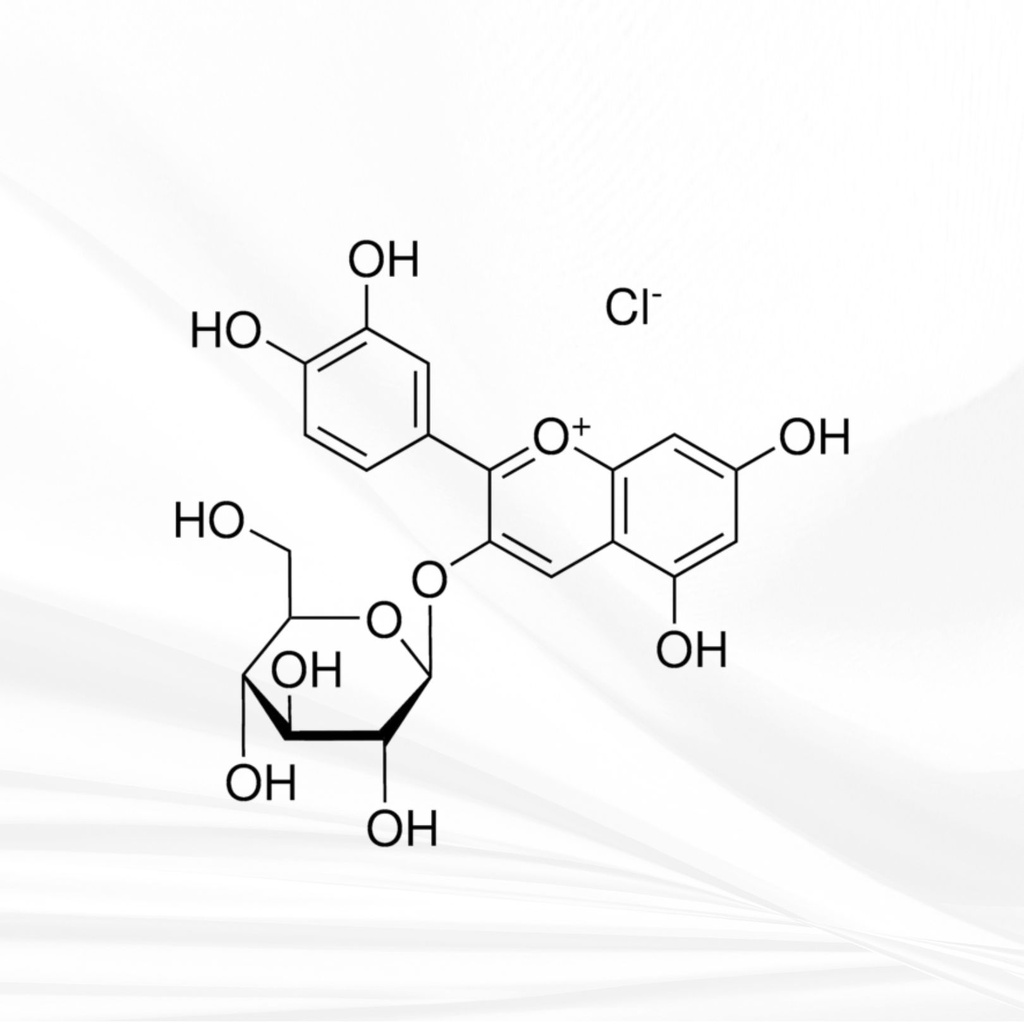
O[C@@H]1[C@@H](O)[C@H](OC2=CC3=C([O+]=C2C4=CC(O)=C(O)C=C4)C=C(O)C=C3O)O[C@H](CO)[C@H]1O.[Cl-]
InChI:
1S/C21H20O11.ClH/c22-7-16-17(27)18(28)19(29)21(32-16)31-15-6-10-12(25)4-9(23)5-14(10)30-20(15)8-1-2-11(24)13(26)3-8;/h1-6,16-19,21-22,27-29H,7H2,(H3-,23,24,25,26);1H/t16-,17-,18+,19-,21-;/m1./s1
InChI key: YTMNONATNXDQJF-UBNZBFALSA-N
General description
This substance is a primary reference substance with
assigned absolute purity (considering chromatographic purity, water, residual
solvents, and inorganic impurities). The exact value can be found on the
certificate. Produced by PhytoLab GmbH & Co. KG
It is a chloride salt of the anthocyanidin glycoside, cyanidin-3-glucoside.
Cyanidin 3-glucoside is the major anthocyanin found in legumes, such as black
soybean, common bean, cowpea, and lentils. It is known to show antioxidant,
anti-inflammatory, antitumor, and antihypertensive properties.
Application
Cyanidin 3-glucoside chloride can be used as a calibration
standard in the identification and quantification of anthocyanins in:
- Artichokes
and botanical raw materials using high-performance liquid chromatography
(HPLC).[1][2]
- Black
rice samples using high-performance thin-layer chromatography(HPTLC).[3]
Biochem/physiol Actions
Anthocyanin. Antioxidant. Studied for its neuroprotective
property.
Other Notes
This compound is commonly found in plants of the genus:
echinacea sambucus zingiber echinacea sambucus zingiber
Legal Information
phyproof is a registered trademark of PhytoLab GmbH &
Co. KG