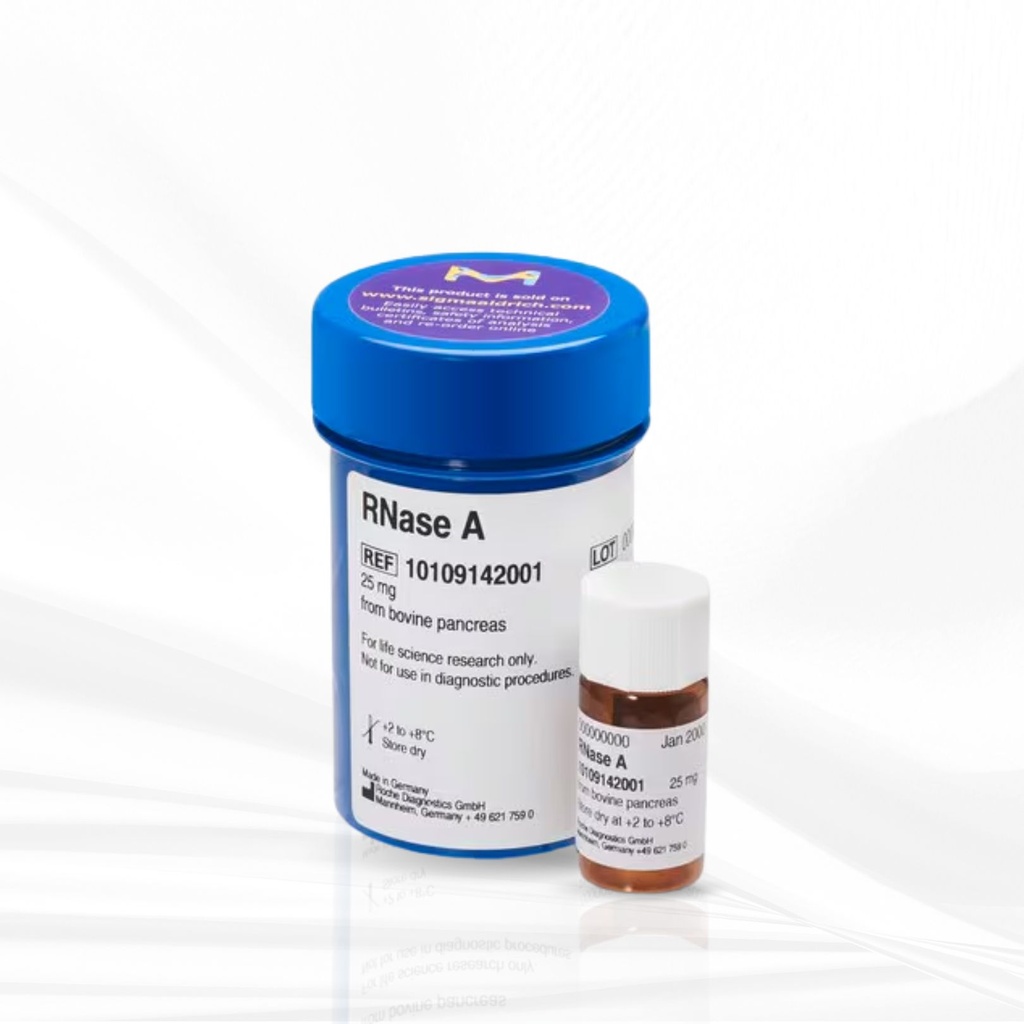
General description
Bovine pancreatic RNase A is a member of the RNase A protein
superfamily. It is one of the most characterized proteins, and is a kidney
shaped basic protein. This protein is composed of 124 amino acids. In its
native form, RNase A exists as a homodimer.[1]
Application
- For
analytical purposes[2]
- Isolation
of DNA (for this purpose, RNase A should be boiled)[3]
- For
cell cycle analysis by flow cytometry and propidium iodide (PI)
staining[4][5]
Biochem/physiol Actions
RNase A catalyzes the transphosphorylation and degradation
of RNA. It was the first protein identified to exhibit DNA melting
functionality. This enzyme binds to several binding sites on single stranded
(ss) RNA polynucleotide chain before degrading it. It interacts with ssDNA in a
similar manner, which is responsible for its ‘DNA unwinding′ property. RNase A
dimer obtained through tandemization shows toxicity to cancer cells.[1]
Preparation Note
RNase A can be dissolved at a concentration of 1 to 10 mg/ml
in 10 mM Tris-HCl, pH 7.5, 15 mM NaCl, heated to 100 °C for 15 minutes to
inactivate contaminating DNases and cooled slowly to room temperature and
dispend into aliquots. Roche recommends subsequent storage at -15 to -25 °C.
Other Notes
For life science research only. Not for use in diagnostic
procedures.
One unit is the enzyme activity that causes a decrease in
absorbance of A0 to A1 within 1 minute under
assay conditions. A0 to A1 corresponds to the
total conversion, A1 being the final absorbance.