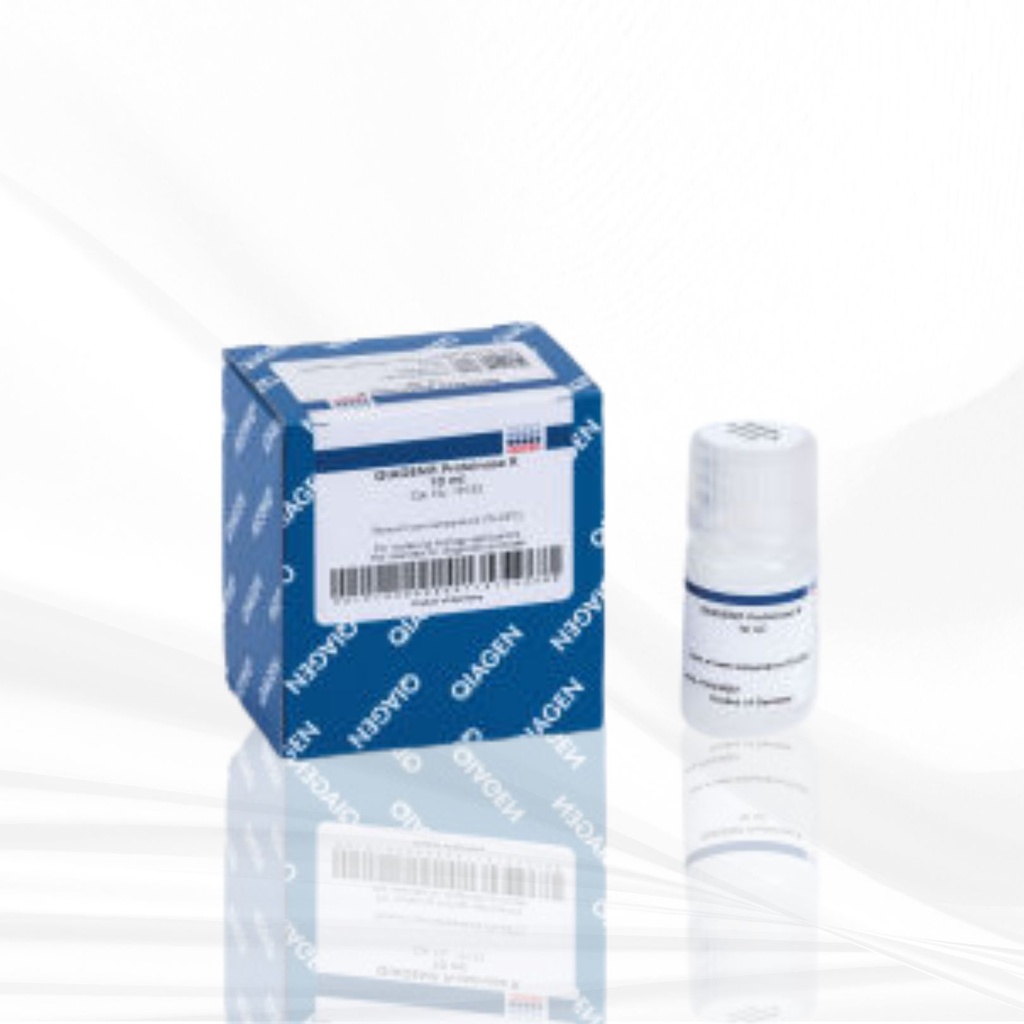
QIAGEN Protease and QIAGEN Proteinase K offer broad substrate specificity with high activity for a wide range of reaction conditions. QIAGEN Proteinase K in 2 mL and 10 mL pack sizes is dedicated for use in various QIAGEN kits (please see list in the Principle section below). As a sample prep expert, QIAGEN also offers Proteinase K as lyophilized powder (Proteinase K Powder). Both proteases offer high activity in buffers commonly used in most DNA and RNA isolation procedures and are quality-guaranteed by QIAGEN.
QIAGEN Protease and QIAGEN Proteinase K
QIAGEN Protease and QIAGEN Proteinase K offer broad substrate specificity with high activity in buffers commonly used in most DNA and RNA isolation procedures. Both enzymes are quality-guaranteed by QIAGEN.
QIAGEN Protease is particularly stable and active at high pH. In Tris-containing buffers of alkaline pH (7.5–10.5) QIAGEN Protease displays 30 to 40% higher specific activity than Proteinase K.
In the presence of strong denaturants, such as urea (0.75–3 M urea) or guanidine HCl (0.5–3.0 GuHCl), the specific activity is comparable to that of Proteinase K, provided the EDTA concentration is less than 8 mM.
QIAGEN Protease shows increased activity in the presence of urea and guanidine HCl. Similar stimulation is obtained upon the addition of up to 1% SDS. Enzymatic activity also increases as a function of
temperature (30–55°C). For more detailed information, refer to the QIAGEN Protease Product Sheet in the Resources section.
The enzyme can be easily inactivated by incubation at 70°C for 15 minutes.
QIAGEN Protease is not inhibited by up to 100 mM EDTA in Tris·Cl buffers. However, in the presence of greater than 1% SDS or other strong denaturants, the EDTA concentration must be less than 8 mM.